Tape automation with libraries: they preserve everything—anytime—for decades
Because you never know what you’ll need again
The sky’s the limit—with a tape library
As your data volumes continue to grow, tape automation provides a scalable archival solution.
With an automated tape changer, capacity bottlenecks all but disappear; tape libraries form the backbone of a solid backup-and-archive strategy and remove the fear of irreplaceable corporate data after any kind of disaster.
Magnetic tape repeatedly proves why it is—if not the most durable, then certainly one of the most durable storage media in the digital world. Depending on the generation, a single cartridge stores many terabytes. Under the current LTO-10 specification you can write 30 TB of compressed data to one tape, or 75 TB if your content is uncompressed text. Multiply those figures across a tape library and the resulting capacity is enormous.
Tape automation works like this: a robotic mechanism, directed by the software, selects the required cartridge and loads it into the library’s LTO drive. Each tape is formatted with LTFS (Linear Tape File System), so the drive can seek straight to the requested file. When the application needs data from another cartridge, the robot swaps tapes automatically.

Mit dem NS372S erhalten Sie ein platzsparendes und vielseitiges SAS-LTO-Rackmount-Enclosure. In das 1HE-Gehäuse des NS372S lassen sich bis zu zwei SAS-Laufwerke der führenden LTO-Hersteller einsetzen. Anschluss finden die LTO-Bandlaufwerke per SFF-8482 Schnittstelle mit 6 Gbit/s. Damit ermöglicht es Nutzern von Mac-Servern mit eingebauten Hostbusadaptern per LTO-LaufwerkDaten direkt auf Band zu sichern.

LTO Library Q24 from Qualstar's Midrange offers superior performance in backup, recovery and archiving applications. Compact but feature rich, it delivers large capacities and high data throughput.
The library can be equipped with one or two of the latest LTO drives. The 2U chassis of the Q24 - for example, equipped with LTO9 drive - reaches capacities of up to 432 terabytes (native) or 1080 terabytes (compressed).
The Q24 is easy to install and maintain. For example, the administrator can replace all major components - such as the tape drive, power supply and controller board - on-site using standard tools. In the integrated control panel, he has access to intuitive, menu-driven controls. This functionality is also available via the integrated browser-based Remote Management Interface (RMI).

The Q40 system offers capacity scaling from 40 to 280 cartridge slots and throughput scaling from one to 21 tape drives. The Q40 uses LTO-7, LTO-8, LTO-9 or LTO-10 tape drives with SAS or FC interfaces.
The Q40 library base module provides up to 720 TB (LTO-9 native) or up to 1.8 PB (LTO-9 compressed) of storage capacity. Connected with up to six additional expansion modules, a single library system achieves up to 12.6 PB (LTO-9 compressed) of storage capacity in a 21U rack.
The Q40 is easy to operate and maintain. For example, the administrator can replace all major components - such as the tape drive, power supply and controller board - on-site using standard tools. In the integrated control panel, he has access to intuitive, menu-driven controls. This functionality is also available via the integrated browser-based Remote Management Interface (RMI).

LTO-Library Q8 aus der Einstiegsklasse von Qualstar bietet eine überragende Leistung bei Sicherungs-, Wiederherstellungs- und Archivierungsanwendungen. Kompakt und doch mit vielen Funktionen ausgestattet, liefert sie große Kapazitäten und einen hohen Datendurchsatz zu einem kosteneffektiven Preissegment.
Die Library kann mit der jeweils aktuellen LTO-Technologie ausgerüstet werden und ist zumindest mit einer weiteren Generation kompatibel. Das 1HE-Gehäuse der Q8 erreicht – beispielsweise mit LTO9-Laufwerk bestückt – Kapazitäten von bis zu 144 Terabyte (nativ) oder 360 Terabyte (komprimiert).
Die Q8 ist auf Zuverlässigkeit und einfache Handhabung ausgelegt. Sie lässt sich daher einfach installieren und warten. So kann der Administrator vor Ort alle wichtigen Komponenten – wie etwa Bandlaufwerk, Netzteil und Controller-Board – mit Standardwerkzeugen austauschen. Im integrierten Bedienfeld hat er Zugriff auf eine intuitive und menügeführte Steuerung. Diese Funktionalität ist auch über das integrierte browserbasierte Remote Management Interface (RMI) möglich.

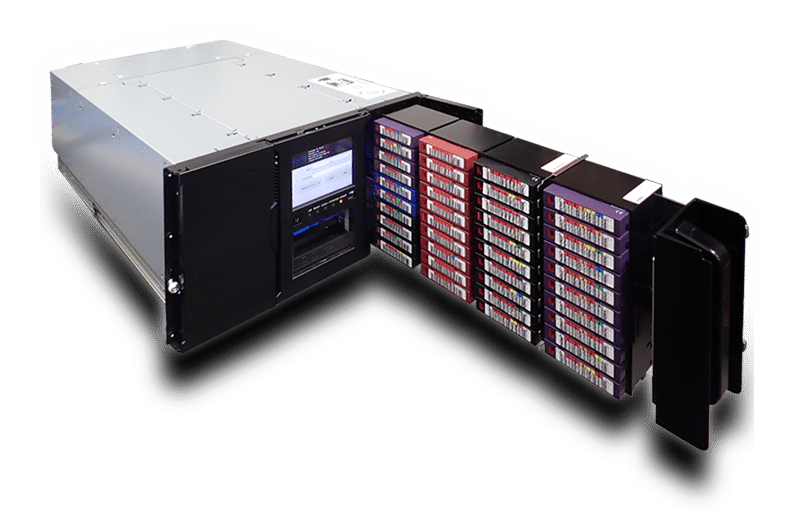
Qualstar's Q80 scalable enterprise tape library is Simply Reliable™ designed to deliver superior performance and scalability for short-term backup, disaster recovery and long-term archiving. The 6U-high libraries work with LTO-7, LTO-8, LTO-9 or LTO-10 tape drives, and each unit provides up to 1.44 PB (LTO-9 native) or 3.6 PB (LTO-9 compressed) of storage capacity.
The Q80 base unit can be connected with up to six expansion modules to create a library system with up to 25.2 PB (compressed) of storage capacity in a single 42U rack. These modular expansions give your Q80 system - along with your businesses - room to grow. You can increase cartridge capacity from 80 slots to 560 slots and boost throughput by adding more tape drives (maximum 42).
Even if you use multiple stacked library modules, the Q80 uses a single robot to service all drives and media, maximizing cost efficiency. The user control panel features an intuitive GUI and setup wizards to easily configure and operate the system. An integrated browser-based Remote Management Interface (RMI) allows administrators to remotely configure, manage, diagnose and diagnose the library from anywhere in the world.
Libraries seamlessly integrated into hardware and software environments
From tapes, tar, and tiering
These robust tape systems connect to the network via SAS or Fibre Channel and are easily addressed in Tier 3 storage pools. Virtually every backup application includes plug-ins to write directly to LTO tapes.
Archiware P5, for example, supports data-type filtering, incremental backups, tape cloning, and full LTFS integration, making navigation on large cartridges straightforward. No additional software or drivers are required to manage LTO media—whether through P5 or direct tape access.
High-performance tape automation
A single LTO-8 drive can write about 1 TB per hour of compressed data—multiplying with every additional drive. Our Q24 libraries house up to two drives, securing roughly 2.7 TB per hour compressed (about 1 TB per hour uncompressed). Because the LTO software handles compression on the fly, there’s no need to pre-package data with tar before archiving.

Starline benefits

Experienced and trained technicians do performance and functional checks and offer quick help in case of failure.

We know which components work together because we test the connectivity extensively in advance.

Starline has been active in the sector since 1982 and is a specialist in all aspects of data storage.

Starline maintains a high level of spare parts and is therefore able to supply spare parts long after the warranty period has expired.
Qualstar has the right model for everyone in its range.
| Model | Q8 | Q24 | Q40 | Q80 |
|---|---|---|---|---|
| Positioning | Entry-level / SMB |
Midrange / SMB |
Enterprise | Enterprise High-End |
| Rack Height (Base / Max.) | 1U | 2U | 3U / 48U | 6U / 42U |
| Slots per Module | 8 | 24 | 40 | 80 |
| Max. Slots | – | – | 640 | 560 |
| Drives per Module | 1 | 1–2 | 1–3 | 1–6 |
| Max. Drives | 1 | 2 | 48 HH or 16 FH + 16 HH | 42 HH or 21 FH |
| LTO Generations | LTO-7 to LTO-9 | LTO-7 to LTO-10 | ||
| Interfaces | SAS, Fibre Channel | |||
| Base Unit Capacity (native) |
up to 144 TB | up to 432 TB | up to 1.2 PB | up to 2.4 PB |
| Fully Expanded Capacity (native) |
– | – | up to 19.2 PB | up to 16.8 PB |
| Max. Throughput (total) | 2.7 TB/h | 5.4 TB/h | up to 129 TB/h | up to 113 TB/h |
| Remote Management | Yes | |||
| Barcode Reader | Yes | |||
| Redundant Power Supplies | No | No | Optional | Standard |
| Partitioning | No | No | Optional | Standard |
| LTFS / WORM | Yes | |||
| Warranty | 3 years (Advanced Replacement Service) | |||
| Compatibility |
Operating systems: MS Windows, Linux, macOS and many more Software: Most common backup and archiving applications |
|||
Find out more about our products in the magazine

Organised tape change: With GFS rotation, you can achieve a largely seamless sequence of your backups.

LTO-9 upgrade: Even tape changers reach their limits at some point. Munich-based media company received prompt support from Starline.

What is behind the two-stage backup D2D2T and its different technical requirements?
